Coarse fishing
Feeder fishing at distance, and why the tip is the instrument
Feeder fishing is legering with a weight that also carries bait, and at range it becomes a different sport from the same rod at ten metres. Two things change: the rod has to throw a loaded feeder, and the bite arrives as a movement in a tip rather than as a pull you feel.
By Jean-Benoit Buisson
Two things change when the feeder goes out to a far bank.
The first: the rod has to throw a loaded weight
An empty feeder and a loaded one are different objects. The rating printed on the rod has to cover the loaded one, and the difference is not small.
The distance rod — 3,90 m, 0 to 220 g
3+3 pieces, 325 g, fourteen rings, fast action, 1,35 m packed.
Reach for a far bank and a rating for a heavy feeder held in current, at 325 g in the hand. The 220 g ceiling is what lets you fish a river rather than only a lake.
The stillwater rod — 3,60 m, 0 to 120 g
3+3 pieces, 270 g, fourteen rings, 1,27 m packed.
Thirty centimetres more reach than the 3,30 m rod on the same shelf for 55 g more weight — and this is the version most stillwaters actually want. Where 3,30 m is short and 3,90 m is unnecessary, it is this one.
If you fish one water, buy the one that fits it. If you fish several, buy the 3,90 m first.
The second: the bite arrives in a tip
You are not holding the line. The bite is a movement of two centimetres in a quiver tip a long way from the fish.
Which is why 3+3 is a real specification and 3+2 is a different rod. Three sections and three tips: a soft one for still water and a shy bite, a stiff one for flow or a crosswind that would bend a soft tip double before a fish touched anything.
Both rods above are 3+3. The cheapest rod on that shelf is 3+2, and the third tip is exactly what it gave up.
The reel
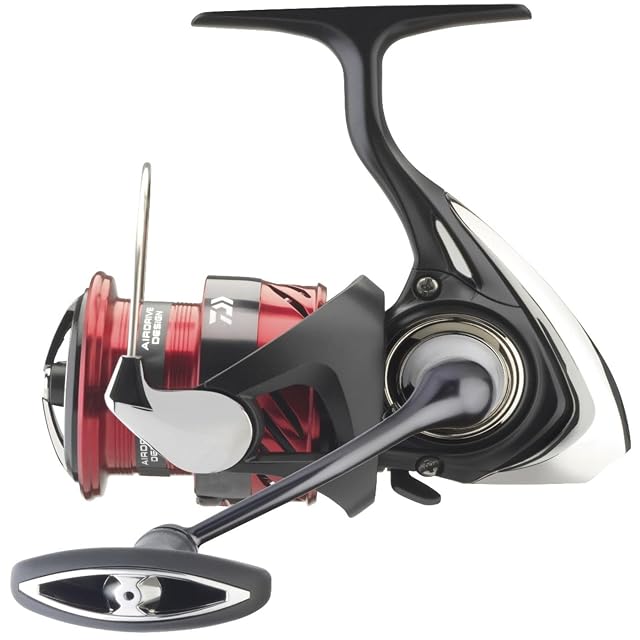
Size 4000, 5,2:1, 150 m of 0,28 mm, 82 cm per turn, 270 g, four bearings, 12,0 kg front drag.
Every figure a reel is bought on, including the retrieve per turn — which is the one you will care about by the fiftieth cast of the session.
The net
A 50 × 50 cm catching area, 40 cm deep, 10 mm mesh, rubberised so it absorbs no moisture and holds no smell, on a robust metal snap triangle with an abrasion-resistant join to the frame.
Three dimensions of the net itself, which six other listings on that shelf do not publish. A feeder-caught bream comes to the bank on its side, and 50 by 50 is what it needs.
Read the feeder shelf first
The method feeders here run from 15 g to 60 g empty, and five of the seven come with a mould — the thing that makes every cast carry the same load. At range, consistency is the method.