Skip to content

Handling pike, without hurting either of you

Everything in pike fishing that goes wrong, goes wrong in the ninety seconds between the net and the water. This list is not about catching them. It is about the part afterwards, and the equipment that decides whether the fish swims off and your hands are intact.

This list is about the ninety seconds after the net.

1. The long net

2,10 m — the longest on its shelf, where the shortest is 67 cm. That is the whole argument: on a high bank, a platform or a boat, a short net means leaning out over the water with a green fish on a short line.

The mesh is rubberised, so a treble does not thread into it, and a transport bag comes with it — which is what keeps a wet net out of the car rather than in it.

Net dimensions and load capacity: not published. Read that as a limit on what you can check, not as a figure.

2. The wide mat

120 × 65 cm, rated to 70 kg, with rubberised mesh panels and handles that also take a scale. A pike overhanging a 30 cm mat is a pike hitting gravel every time it moves.

Wet it first. The listing says so, and the reason is the mucus layer — the coating a fish depends on against infection, and the thing a dry surface takes straight off.

3. The rod

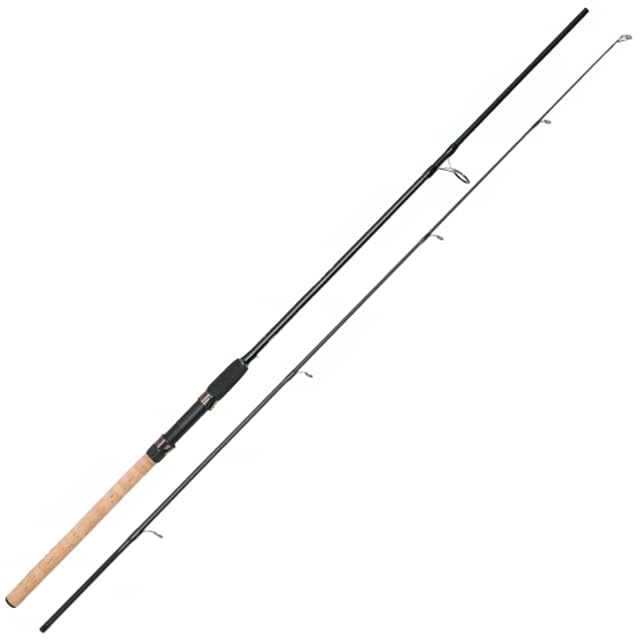
2,30 m, rated 60–90 g — the only rod on that shelf rated past 25 g. A plug-in blank, a cork handle, aluminium oxide rings.

That rating is not a light-spinning rod and does not pretend to be: it is for big swimbaits and static deadbaits, the two pike methods a 3–12 g rod cannot throw.

4. The reel

Low profile, 7,1:1, 9+1 stainless bearings, an X-Craftic aluminium frame, a MagTrax magnetic brake and a Carbon Matrix drag.

Frame, brake and drag all have designations, which on this shelf is unusual — everything here can be looked up rather than taken on trust. On a baitcaster the brake is what stops an overrun with a heavy lure, and that is the part worth having a name for.

Check the hand before ordering: it is left hand, and a baitcaster cannot be converted.

The two things not in this list

Long pliers and a wire trace. Both are on this site, both are accessories rather than reviews, and both are what actually get the hook out.

Read the plier shelf before your first pike. The difference between an 18 cm plier and a 28 cm one is the distance between your knuckles and a set of backward-facing teeth.
The list, and the reason for its order

What this guide leaves open

Why a 2,10 m landing net?

Because a pike is landed from where you are standing, and on a high bank or a platform that is a metre or more above the water. Reaching down with a 67 cm net means leaning out over the water with a green fish on a short line — which is how both of you get hurt.

Why does the mat need to be that wide?

A pike is long and a carp is deep, and a mat has to take whichever you catch. Sixty-five centimetres is double the width of five other mats on that shelf, and a pike thrashing on a mat it overhangs is a pike hitting gravel.

What about the tools?

They are accessories, so they are not in this list, but read the shelf before you need it: one plier there is 28 cm long and arrives with a right-hand glove, one is 24,5 cm with a spring that reopens the jaws between grips, and one is a locking hemostat that clamps shut instead. Length is what keeps your knuckles outside the teeth.

Do I need a wire trace?

For pike on lures, yes, and this site has a shelf of them. Three materials sit on it — steel, titanium and tungsten — and the two expensive ones make the same claim in different words: no memory, so a trace kinked in a pike’s jaw springs back straight rather than being thrown away.

How this guide is built

The models here come from the catalogue of this site. Specifications are those published by the manufacturer and on the Amazon product page; prices are what Keepa reported on the date below, and both move. The ranking uses declared specifications, the balance of stated strengths and limitations, and price. No product on this site has been physically tested, and nothing here claims otherwise.

Last checked on

The tool we use ourselves

Reference settled? The figure beside it still has to be worth something.

Tackle gets bought the week before the trip, which is the worst possible moment to judge a price: demand on these shelves climbs from March and falls away after September, so a figure struck through in June says nothing whatever about what the same reference cost in December. UniverTrack keeps a week-by-week history for each retailer, so a reduction can be held against a figure somebody actually paid rather than one written for the banner — and it says when the moment to order has genuinely come.

Real price historyBuy-now alertsAI buying assistant
Try free for 14 days →
No commitment · Cancel in one click · 5 languages