Skip to content

The best waders for 2026

A chest wader is a boot and a trouser in one piece, and the boot is the part that decides the purchase. Every listing on this shelf sells the pair with boots attached — « mit Stiefel », « mit Stollenstiefel », « mit Gummistiefeln » — which is why the size in the title is a shoe size and not a waist: Gr. 43 and Gr. 44 on the Heimfleiss at 74,99 €, EU 46 on the Shakespeare Sigma, 42 and 43 on the Night Cat at 59,99 €. Nothing here is adjustable, so the shoe size is the whole fit. The material splits the shelf in two, and it is a real difference rather than a price tier. Neoprene — the Shakespeare Sigma, the Ansobea « Neopren 70D Nylon » at 29,99 € — is warm, stretches, and does not breathe: it is the choice for cold water and standing still. Nylon or PVC — the Lekesky two-layer nylon/PVC at 52,99 €, the SWANEW « 70D Nylon Composite PVC » at 27,59 € — is lighter and cooler, and the Night Cat pair name the property that matters in summer: « atmungsaktiv », breathable. A wader that does not breathe is wet inside by the end of a July morning whether it leaks or not. Two details in the titles are worth the reading. The sole: « Stollenstiefel » is a cleated sole, « rutschfeste Gummistiefel » a plain rubber one, and neither grips wet rock the way a felt sole does. And the height: « Brustwathose » is a chest wader, and a waist-high pair is a different tool for a different river. The shelf runs 27,59 € to 75,98 €. We compare material and thickness, boot size and sole, breathability, height, pocket, belt loops and size range.

One table, every figure this shelf publishes

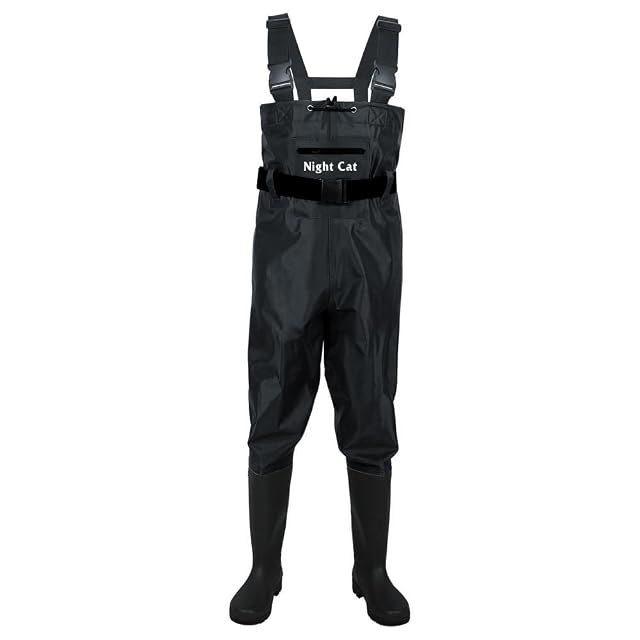
  1. Night Cat Size 43

    Nylon-reinforced PVC body with waterproof boot attachment and welded seams · PVC cleated, thickened boots, slip- and abrasion-resistant · adjustable H-back braces with quick-release buckles · fold-out chest pocket with a top drawcord · sizes 40 to 47 · rinse with fresh water after use, do not brush

    The only listing here that states its whole size run and how to look after them.

    Best for: A first pair, with the size run checked before ordering

    7.8/10

    ≈ $50

By need, across waders

Stay dry

Waders are judged on their seams before their material. Welded seams, stated on several listings, are what lasts.

Grip the bottom

The sole decides the grip on pebbles and silt. Cleated rubber is the standard of this aisle, and it slips on wet rock.

Be worn without hindrance

Adjustable braces and reinforced knees decide comfort and durability. They are the two points every listing describes.

Across waders, who each type suits

River and bank
A coated-nylon bootfoot wader, reinforced knees, cleated sole. It is the most common configuration in this aisle.
Cold water
Neoprene insulates where nylon only protects. It weighs more and breathes less.
Three trips into the water a year
A simple PVC model costs little and lasts less. It is a deliberate choice when you go into the water three times a year.

The trade-offs to weigh on waders

Welded seams against price
Welding holds better than stitching and costs more. It is the item on which a cheap wader eventually gives way.
Cleated sole against wet rock
Cleated rubber grips gravel and slips on stone covered in algae. Felt or studded soles exist, and this aisle offers none.
Belt never mentioned
No listing recorded speaks of a wading belt. It is nonetheless what limits the water coming in after a fall, and it is a basic precaution.

What gets asked about waders

What wader size should you take?

The boot size, since the boot is built in. A boot that is too big lets the foot slide and tires you quickly.

Nylon or neoprene?

Nylon protects from the water without insulating; neoprene insulates and weighs. In cold water, neoprene changes how long you can bear it.

Do you need a wading belt?

Yes, and no listing in this aisle mentions one. Tightened at the waist, it limits the volume of water that enters after a fall.

How do you repair a punctured wader?

With glue or a patch made for the material. You find the leak by shining a light from the inside in the dark.

Are cleated soles enough?

On gravel and silt, yes. On rock covered in algae they slip, and you then need suitable oversoles.

How do you store waders?

Dry, hung by the braces, without folding them in the same places. Repeated creases eventually crack the coating.

What are reinforced knees worth?

They extend the life of the garment markedly, because that is where you kneel. Every listing in this aisle states them.

Can you swim in waders?

It is very difficult once they fill. The belt, staying calm and floating on your back are what get you to the bank.

The essentials of waders

The seams decide whether you stay dry, the sole decides the grip, the reinforced knees decide durability. No listing in this aisle mentions a wading belt, which is nonetheless the simplest precaution against filling — and these cleated soles slip on rock covered in algae.

The figure beside a product asked the shop for itself the moment this page opened; a figure inside the text has sat still since the sentence was written, and the first of the two is the one to trust.