Travel
Travelling with tackle, and the figure almost nobody publishes
If your fishing involves a flight, a train or a small car, one number outranks every other on the listing: the packed length. It is the figure most sellers leave out, which makes the few who publish it unusually easy to choose between.
By Jean-Benoit Buisson
One number, and most sellers do not print it: the packed length.
The section set that becomes five rods
Ten interchangeable sections making 220 cm spinning, 220 cm bait, 190 cm casting, 220 cm fly and 190 cm heavy fly, with a 5-bearing reel at 5,1:1 and a single-bearing fly reel.
It is not a fly rod; it is a set of sections that becomes one, among four others. If you travel with hand luggage only and one tube has to cover fly, spinning and bait, this is the object built for exactly that.
The carp rod — 67 cm packed
Telescopic, six or seven sections, 67–69 cm packed, 220–295 g, and a casting weight in grams — 30–70 g or 40–90 g depending on the version — instead of a test curve.
Sixty-seven centimetres is the figure. It is the one rod here that goes inside a suitcase rather than alongside it, and the gram rating is easier to match to a lead than a pound test curve is.
The pole — 45 cm packed
Four metres of glass fibre telescopic pole, 45 cm packed.
The most extreme transport figure in the whole corpus: four metres of rod in a 45 cm package. A pole is the most awkward thing in fishing to transport and the easiest to fish with once you are there, and this is the one that solves the first half.
The short spinning rod
1,83 m, 3–14 g, 24T carbon, LTS SIC stainless rings, cork handle, stated for fresh and salt water.
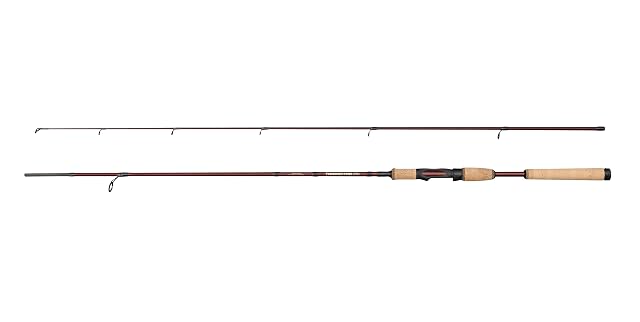
Not telescopic and not sold as a travel rod — it is here because 1,83 m is short in itself, which is what makes it the rod for close-quarters work under trees at the other end, and for light shore work in salt.
The boat rod
210 cm, 20–30 lbs line class, four pieces, 24T carbon, Fuji stainless guides with aluminium oxide rings, Cordura tube.
Four pieces and a tube, which is what a boat rod needs to travel at all. Note two things: the packed length is not published, so measure the tube against your case when it arrives; and the rating is a line class in pounds, not a casting weight in grams, so it cannot be compared directly with the rods above.
What packs worst
Nets. A rigid handle is the single most awkward object in a fishing bag. Several nets on this site fold at a button to a size that goes inside a case, and one folds from 90 cm to 67.
Anything with a point. Hooks, disgorgers, scissors, pliers: hold luggage, every time. Rules vary by carrier and they change; read the airline’s own page before you pack rather than finding out at the desk.